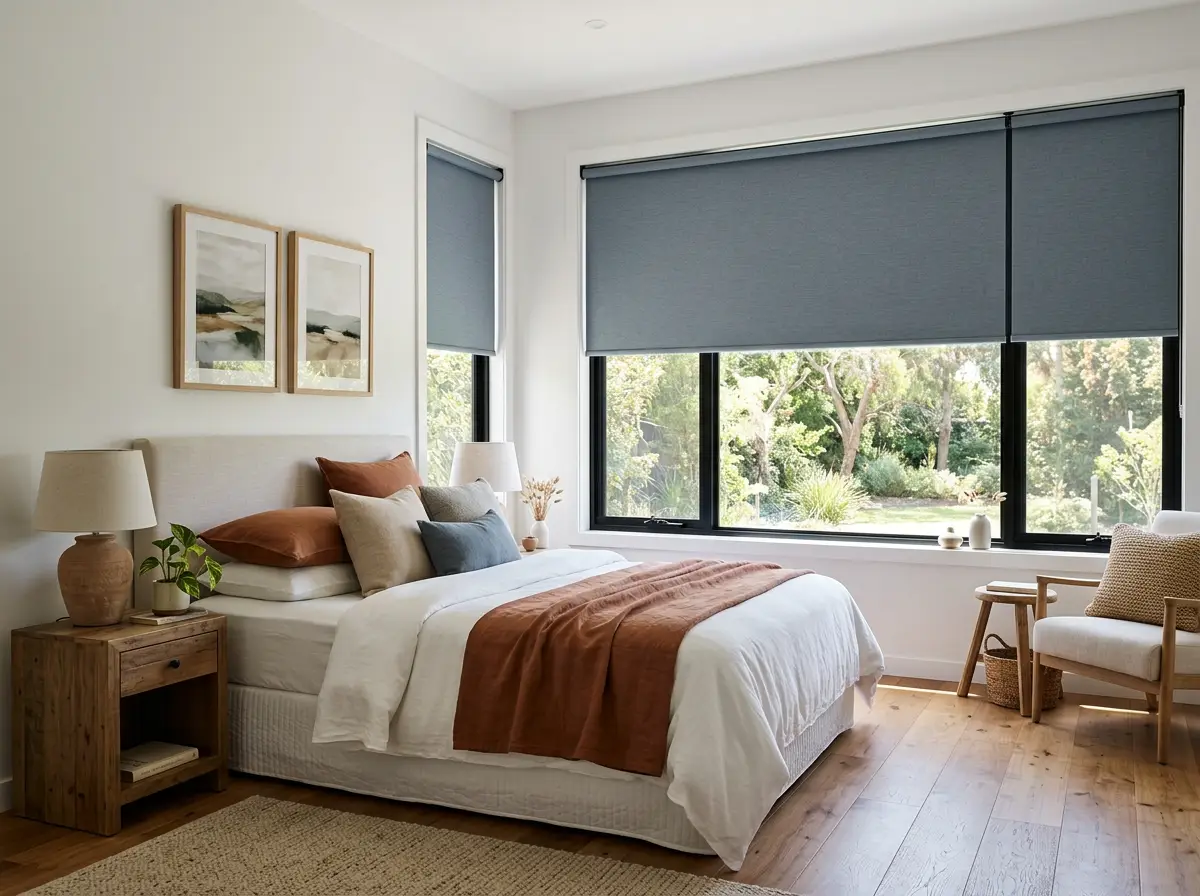
The core decision: which fabric
Every roller starts with the same question — what do you actually need the window to do? On Craighall Park's garden-facing glass, under a canopy of established trees, that's usually about keeping the view while losing the glare; on street-facing or west-facing rooms, it's about heat and privacy for a young family.
- Blockout — total light stop for bedrooms, nurseries and media rooms, with a genuine thermal benefit against both summer heat and winter chill.
- Sunscreen (3%, 5% or 10% openness) — a mesh weave that cuts glare and UV while keeping the garden view. Lower percentages block more heat and glare but show less view; 3–5% is the standard choice on windows overlooking a lawn you don't want to lose.
- Light-filtering / translucent — softens daylight with full privacy, no view through — a good match for rooms overlooked by a neighbouring double-storey addition.
Options worth knowing about
- Double roller (day/night combo) — blockout and sunscreen sharing one bracket, the practical answer for a kid's room that still wants garden light during the day.
- Control — chain (fitted with a child-safe tensioner as standard), spring-assist, or motorised for anything wide, high, or awkward to reach.
- Cassette pelmets — hide the tube and colour-match the fascia to your frames or ceiling for a tidier finish, particularly on renovated rooms.
Very wide unbroken spans (beyond around 3m of fabric) need either a central join line or a motorised, linked system — we'll flag it honestly at the measure rather than promise a seamless single blind that won't perform. And on original rooms with real period proportions, a timber venetian often simply looks more at home than a roller — we'll say so if that's the case for your window.
What a roller blind costs
Working by the square metre installed, and as a guide: a hand-operated roller in blockout, sunscreen or a light-filtering weave prices at R1,000 to R1,600, cheapest as plain blockout and dearest as a fine sunscreen on garden glass or a double roller carrying both. Add a motor and the guide rises to R2,500 to R3,800.
Before you do the sums: a cloakroom window consumes much the same bracket, tube and labour as a lounge one, so anything tiny attracts a minimum rather than an area rate. Cassette pelmets, side channels and colour-matched fascias appear separately, and on a span beyond about three metres the joined or linked solution is priced honestly. The free measure fixes it in writing.