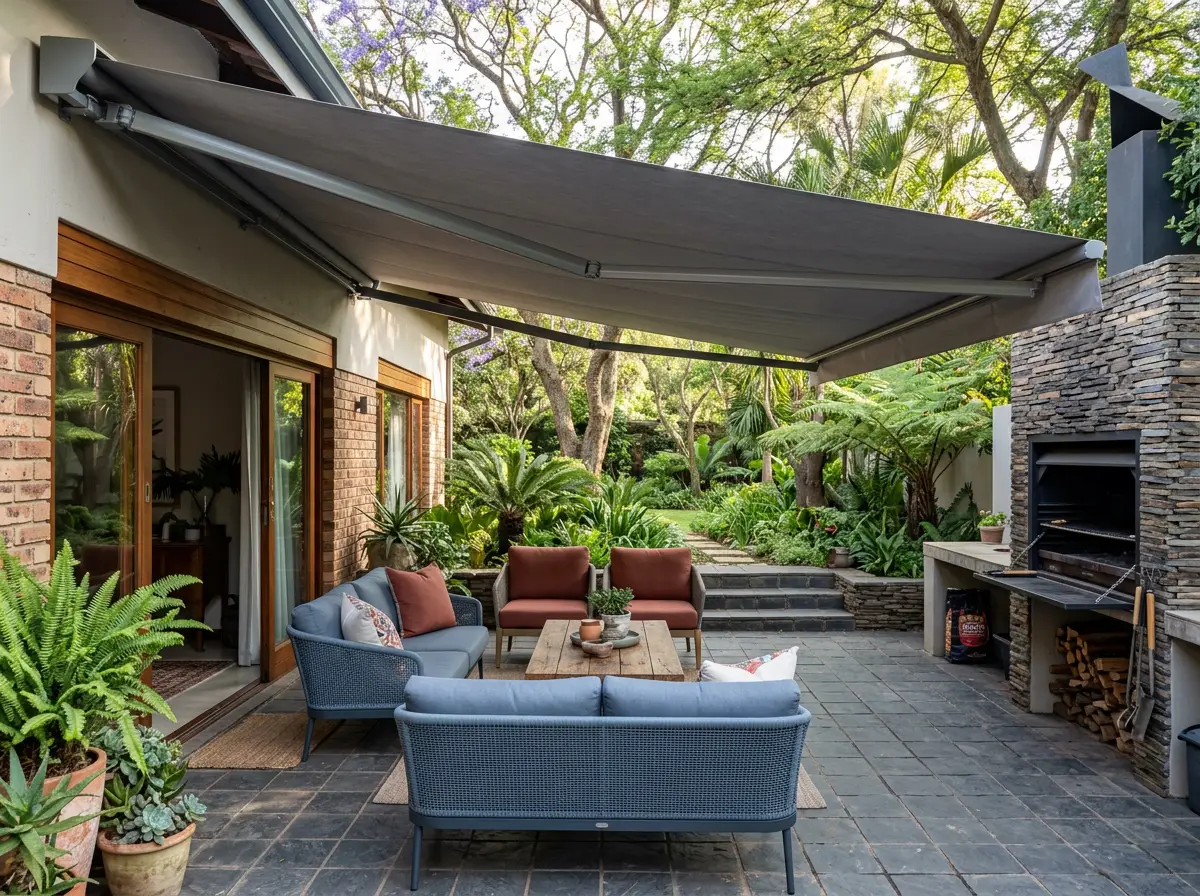
Folding-arm awnings
Retractable fabric on spring-tensioned folding arms — no posts, no permanent roof, no interrupted view of the lawn. It turns a baking north or west-facing patio back into a usable room in summer, and retracts to let welcome winter sun through — an argument a fixed roof simply can't make.
- Mounting — full cassette (fabric and arms sealed away, best for weather-exposed positions), semi-cassette, or open mounting.
- Control — crank handle or motorised. Motor plus wind sensor is the responsible spec: an awning caught open in a highveld thunderstorm gust can be destroyed, and auto-retract protects the investment.
- Fabric — solution-dyed acrylics that hold colour under South African UV, in a projection class to roughly 3–4m over wide spans.
Zip screens
Vertical exterior screens running in zipped side channels — mesh or PVC fabric locked tight on both edges, sealing a patio or entertainment area against sun, wind and insects. Unlike an ordinary drop roller, the zipped edge holds real tension, so it doesn't flap or escape its guides in wind — the practical way to turn a patio into a genuine year-round outdoor room.
- Sunscreen mesh for view-out, glare-down, insect-out daytime use, or clear PVC panels for a wind-and-rain-proof winter braai room that keeps the garden visible.
- Motorisation standard on wide spans, with wind-sensor retract for exposed positions.
Both products are shade solutions, not rain solutions — light drizzle at a pitch is fine, but neither is built for standing water or a genuine storm. Wind ratings are real limits, not suggestions, which is exactly why the wind sensor matters on an exposed Craighall Park stand.
What patio shading costs
The guide runs by the square metre of projection, installed — the shade thrown over the patio, not the wall width. Crank-operated: R3,500 to R5,500, an open or semi-cassette mounting cheapest and a full cassette dearest. Add motorisation and a wind sensor and it is R5,500 to R7,500. Zip screens are guided by the square metre of screen instead, at R2,800 to R4,500 hand-operated and R4,000 to R6,000 motorised.
A compact awning or a narrow screen bay attracts a minimum, because brackets, arms, channels and crew time do not halve when the size does. Substrate can move the figure as well, since a timber fascia or a rendered parapet sometimes needs what solid brick does not. On a Johannesburg summer patio the motor and wind sensor are a specification decision rather than a luxury, explained at the measure before it reaches the written quote.